
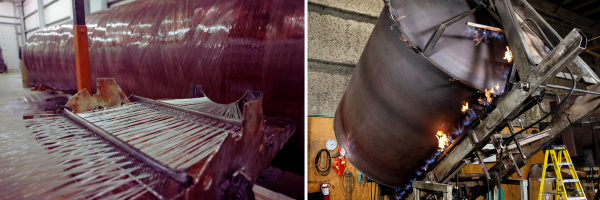
Material Performance in Wastewater Environments
Material selection is critical due to the corrosive nature of wastewater and associated chemicals. FRP (Fiberglass Reinforced Plastic) and HDPE (High-Density Polyethylene) are widely used for process tanks because they offer:
- High resistance to chemical and biological corrosion
- Long service life in aggressive environments
- Structural flexibility under variable loading conditions
- Lower lifecycle maintenance compared to steel or concrete
These properties make FRP and HDPE particularly well-suited for biological treatment systems and applications with continuous exposure to moisture, gases, and chemical by-products.
Fabrication Precision and System Reliability
Design specifications alone do not ensure performance. Fabrication tolerances, weld quality, and structural integrity directly affect tank performance and longevity. Poor fabrication can result in:
- Leakage or joint failure
- Structural deformation under load
- Installation misalignment with system components
- Increased operational risk and maintenance costs
Consistent fabrication quality is essential to maintain system performance and structural reliability.
Advantages of In-House Fabrication
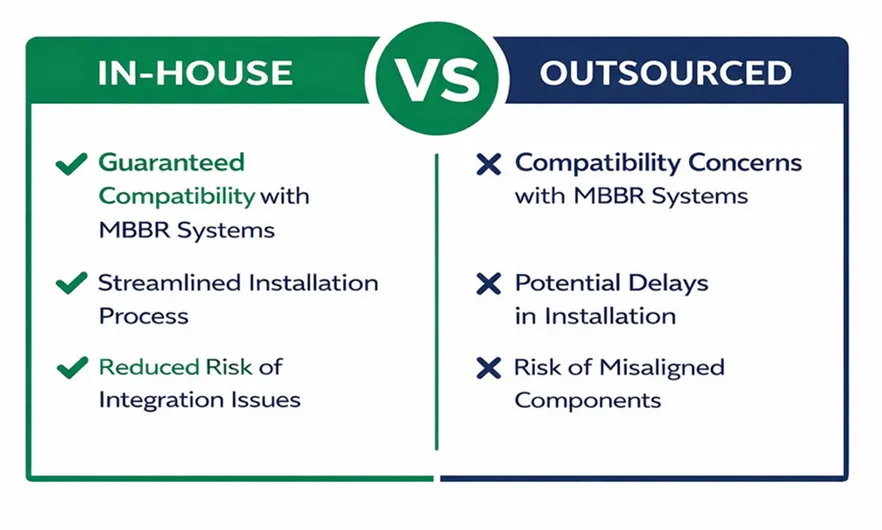
At Canwest Tanks & Ecological Systems, tanks are fabricated in-house to maintain process control and ensure design specifications are consistently met. This approach improves:
- Quality assurance and inspection control
- Fabrication tolerances and dimensional accuracy
- Integration with process equipment
- Project timelines by reducing external fabrication dependencies
Outsourced fabrication can introduce delays, dimensional inconsistencies, and integration challenges during system installation.
Tank Design Considerations for MBBR Systems
For Moving Bed Biofilm Reactor (MBBR) systems, tank geometry and fabrication precision directly affect process performance. Proper tank design ensures:
- Uniform hydraulic flow distribution
- Effective carrier media circulation
- Adequate mixing and oxygen transfer conditions
Optimized tank design supports stable biofilm growth and consistent biological treatment performance.
Summary
Wastewater treatment performance depends on the integration of material selection, fabrication quality, and process design. Using corrosion-resistant materials such as FRP and HDPE, combined with controlled in-house fabrication, improves system reliability and long-term operational performance.
Canwest Tanks & Ecological Systems integrates engineering design and fabrication to ensure tanks meet the performance requirements of modern biological treatment systems.